Strict Liability Product Law Explained
Understand the concept of strict liability in product liability personal injury law.
Understand the concept of strict liability in product liability personal injury law.
Strict Liability Product Law Explained
What is Strict Liability in Product Liability Law
Hey there! Ever wondered what happens when a product you bought, used exactly as intended, suddenly causes you harm? It's a pretty scary thought, right? Well, in the world of personal injury law, there's a concept called 'strict liability' that often comes into play in these situations, especially when we're talking about defective products. It's a big deal, particularly in places like the USA, and it's something consumers in Southeast Asia are increasingly becoming aware of as well.
So, what exactly is strict liability? In simple terms, it means that a manufacturer, distributor, or seller can be held responsible for injuries caused by their defective product, even if they weren't negligent in making or selling it. Yeah, you heard that right – even if they weren't negligent. This is a huge departure from traditional negligence claims where you'd have to prove that the company acted carelessly or failed to exercise reasonable care. With strict liability, the focus shifts from the manufacturer's conduct to the product itself. If the product is defective and that defect caused your injury, the company is on the hook.
This legal doctrine is designed to protect consumers. Think about it: as an average person, how are you supposed to know all the intricate details of a product's design, manufacturing process, or testing procedures? It's practically impossible! Strict liability places the burden on the companies that are in the best position to ensure their products are safe before they hit the market. It encourages them to be extra careful, knowing that they can be held accountable regardless of their intent or direct fault.
It's also important to note that strict liability doesn't mean the company is an insurer against all possible injuries. You still have to prove a few key things: first, that the product was indeed defective; second, that the defect existed when the product left the manufacturer's control; and third, that this defect directly caused your injuries. We'll dive deeper into these elements in a bit.
Historical Context and Evolution of Strict Product Liability
Where did this idea even come from? Strict liability in product cases isn't some ancient law; it's a relatively modern development, especially prominent in the mid-20th century. Before strict liability, if you were injured by a product, you usually had to sue under a theory of negligence or breach of warranty. Proving negligence was tough because you had to show the manufacturer was careless. Breach of warranty claims often had their own limitations, like requiring you to be in direct contractual relationship with the seller (known as 'privity of contract').
The legal landscape started shifting as manufacturing processes became more complex and products reached consumers through long distribution chains. It became increasingly difficult for injured consumers to pinpoint exactly where the negligence occurred. Courts and legal scholars recognized this imbalance and started looking for ways to better protect consumers.
A landmark case in the USA, Greenman v. Yuba Power Products, Inc. (1963), is often cited as a pivotal moment. In this case, a man was injured by a defective power tool. The California Supreme Court ruled that a manufacturer is strictly liable in tort when an article it places on the market, knowing that it is to be used without inspection for defects, proves to have a defect that causes injury to a human being. This decision really opened the floodgates for strict liability claims across the United States.
Since then, strict liability has been adopted in various forms by most U.S. states. While the specifics can vary from state to state, the core principle remains: if a product is defective and causes injury, the responsible parties in the chain of distribution can be held strictly liable. This evolution reflects a societal decision to prioritize consumer safety and place the costs of defective products on those who profit from their sale.
Key Elements to Prove a Strict Liability Product Claim
Alright, so you think you might have a strict liability claim. What do you need to show? There are generally three main things your personal injury lawyer will focus on proving:
1. The Product Was Defective
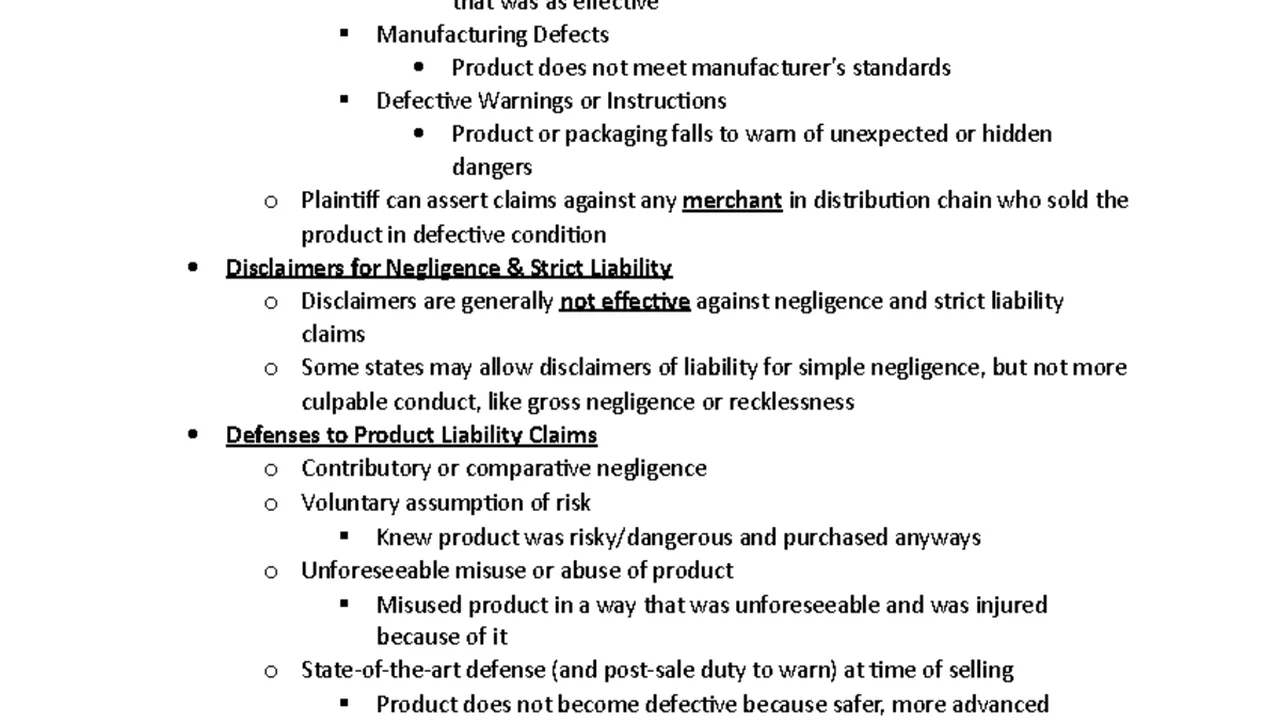
This is the absolute cornerstone of any strict liability claim. The product has to be defective in some way. And when we talk about defects, the law usually recognizes three main types:
- Manufacturing Defects: This is when a product departs from its intended design, even though all possible care was exercised in the preparation and marketing of the product. Think of it like this: the design was perfect, but something went wrong on the assembly line. Maybe a batch of car brakes had a faulty component, or a specific toy had a loose part that shouldn't have been loose. It's an anomaly, a flaw in one or a small batch of products, not the entire product line.
- Design Defects: Here, the problem isn't with how the product was made, but with its very blueprint. The design itself is inherently dangerous, even if the product was manufactured perfectly according to that design. For example, a car model might have a design flaw that makes it prone to rollovers, or a medical device might have a design that causes it to fail prematurely. To prove a design defect, you often have to show that there was a safer, economically feasible alternative design available at the time the product was made.
- Warning Defects (or Marketing Defects): This type of defect isn't about the product's physical form, but about the information (or lack thereof) provided with it. This happens when a product has inherent dangers that aren't obvious to the ordinary user, and the manufacturer fails to provide adequate warnings or instructions for safe use. For instance, a medication might not clearly list all its potential severe side effects, or a power tool might lack warnings about specific hazards during operation. The key here is that the danger was foreseeable, and a reasonable warning could have prevented the injury.
2. The Defect Existed When the Product Left the Manufacturer's Control
This is super important. You can't just claim a product became defective after you dropped it down a flight of stairs. You need to show that the defect was present when the product was sold or otherwise left the control of the manufacturer or distributor. This often involves expert testimony, examining the product itself, and looking at manufacturing records. If the defect arose because you misused the product in an unforeseeable way, or if you significantly altered it, your claim might be in trouble.
3. The Defect Directly Caused Your Injuries
Finally, there needs to be a clear link between the product's defect and your injuries. This is called 'causation.' It's not enough that the product was defective and you got hurt; the defect must be the direct cause of your harm. For example, if a defective car airbag failed to deploy, and you suffered head injuries as a result, that's a clear causal link. But if the airbag was defective, but your injuries were caused by something else entirely (like a pre-existing condition unrelated to the crash), then causation might be harder to prove.
Who Can Be Held Strictly Liable in Product Cases
One of the great things about strict liability is that it doesn't just target the company that made the product. It can extend to anyone in the 'chain of distribution.' This means you might be able to sue:
- The Manufacturer: This is the obvious one – the company that designed and produced the product.
- The Distributor or Wholesaler: These are the middlemen who get the product from the manufacturer to the retailers.
- The Retailer: The store where you actually bought the product. Even if they just sold it and didn't know about the defect, they can still be held strictly liable.
This broad reach is beneficial for consumers because it gives them more options for seeking compensation. Sometimes, the manufacturer might be a small company that's hard to track down or has limited assets. Being able to sue a larger, more established retailer or distributor can make it easier to recover damages.
Strict Liability vs Negligence in Product Cases
Let's quickly recap the big difference between strict liability and negligence in product cases, because it's crucial:
- Negligence: You have to prove the defendant (manufacturer, seller, etc.) acted carelessly or failed to meet a reasonable standard of care, and that this carelessness caused your injury. It's about their conduct.
- Strict Liability: You don't need to prove carelessness. You just need to prove the product was defective and that defect caused your injury. It's about the product itself, not the defendant's conduct.
This distinction is why strict liability is often preferred by plaintiffs in product liability cases. It simplifies the legal battle significantly by removing the need to delve into the manufacturer's internal processes to find fault.
Defenses to Strict Product Liability Claims
Of course, companies aren't just going to roll over and pay up without a fight. They have defenses they can raise. Some common ones include:
- Product Misuse: If you used the product in a way that was unforeseeable and contrary to its intended purpose, and that misuse caused your injury, the company might argue they aren't liable. For example, using a hairdryer to dry your clothes in the shower (don't do that!).
- Assumption of Risk: If you knew about the defect and its danger, and voluntarily chose to use the product anyway, you might have 'assumed the risk' of injury. This is a tough defense for companies to prove.
- Substantial Alteration: If you or someone else significantly modified the product after it left the manufacturer's control, and that alteration caused the defect or injury, the company might not be liable.
- Statute of Limitations: There's a time limit for filing lawsuits. If you wait too long after your injury, you might be barred from bringing a claim, regardless of how strong your case is. These deadlines vary by state and country.
- Comparative Fault: In some jurisdictions, if your own negligence contributed to your injuries, your compensation might be reduced proportionally. This isn't a complete defense but can impact the amount you recover.
Strict Liability in the USA vs Southeast Asia Product Law
Now, let's talk about how this plays out in different parts of the world, specifically the USA and Southeast Asia. The USA is generally considered a leader in consumer protection and product liability law, with strict liability being a well-established doctrine across most states.
United States
In the U.S., strict liability is a powerful tool for consumers. The legal framework is robust, with extensive case law and statutes supporting these claims. Damages can include medical expenses, lost wages, pain and suffering, and sometimes even punitive damages (designed to punish the defendant for egregious conduct). The availability of jury trials also means that ordinary citizens get to decide these cases, which can sometimes favor consumers.
Southeast Asia
The situation in Southeast Asia is a bit more varied and evolving. Many countries in the region are developing their product liability laws, often drawing inspiration from Western legal systems but adapting them to their local contexts. While some countries might have elements of strict liability, others might still primarily rely on negligence or contractual warranty claims. Consumer protection laws are strengthening, but the enforcement and judicial interpretation can differ significantly from country to country.
- Thailand: Has a Product Liability Act that incorporates elements of strict liability, making manufacturers and sellers liable for damages caused by unsafe products, even without proof of negligence.
- Malaysia: Product liability claims often fall under the Consumer Protection Act, which includes provisions for strict liability against manufacturers for defective products.
- Singapore: While not explicitly having a standalone strict product liability statute like some U.S. states, product liability claims can be brought under the Consumer Protection (Fair Trading) Act and through common law principles, which can sometimes achieve similar outcomes to strict liability in practice.
- Vietnam: Product liability is primarily governed by the Law on Product Quality, which places responsibility on manufacturers and sellers for defective products, often leaning towards a negligence-based approach but with increasing consumer protection.
- Indonesia: The Consumer Protection Law provides a framework for product liability, but proving fault can still be a significant hurdle, often requiring a demonstration of negligence.
So, while the trend in Southeast Asia is towards stronger consumer protection, it's crucial to consult with a local personal injury lawyer who understands the specific laws and precedents in the country where the injury occurred. The legal landscape is not as uniform as in the U.S.
Examples of Products and Scenarios Where Strict Liability Applies
Let's get practical. What kind of products are we talking about? And what are some real-world scenarios?
Automotive Defects
Cars are a prime example. Imagine a car with a defective airbag that fails to deploy in a crash, leading to severe head injuries. Or a vehicle with a faulty braking system that causes an accident. Even a tire that unexpectedly blows out due to a manufacturing flaw. In these cases, if the defect existed when the car left the factory and directly caused the injury, strict liability can apply. Think about the massive recalls we see – often, these are preemptive actions by manufacturers to avoid strict liability lawsuits.
Medical Devices and Pharmaceuticals
This is a huge area. A defective hip implant that fails prematurely, requiring painful revision surgery. A pacemaker that malfunctions. A medication that causes severe, undisclosed side effects. These are all potential strict liability cases. The manufacturers of these products are held to a very high standard because the stakes are literally life and death. For example, if a specific brand of insulin pump has a known design flaw that leads to incorrect dosing, causing harm to patients, the manufacturer could be strictly liable.
Children's Products and Toys
When it comes to kids, safety is paramount. A toy with small, detachable parts that pose a choking hazard due to a design flaw. A crib with slats that are too wide, trapping a child's head. A car seat that fails to protect in a crash because of a manufacturing defect. These are all situations where strict liability is often applied to protect the most vulnerable consumers.
Household Appliances and Tools
Even everyday items can be dangerous if defective. A faulty toaster that catches fire. A power drill that sparks and causes an electrical shock. A ladder that collapses due to a weak joint. If these products are defective and cause injury, strict liability can be a pathway to compensation.
Specific Product Examples and Comparisons
Let's consider some hypothetical (but realistic) examples to illustrate the comparison of products and potential strict liability scenarios.
Example 1: Electric Scooters
Electric scooters have become incredibly popular, but they've also led to a rise in injuries. Let's compare two hypothetical models:
- Scooter A (e-Glide Pro): This model is known for its powerful motor and sleek design, retailing for around $800. However, there have been reports of the braking system failing unexpectedly, particularly when going downhill, due to a manufacturing defect in the brake caliper.
- Scooter B (Urban Cruiser): Priced at $650, this scooter is generally reliable. However, its user manual has been criticized for not adequately warning users about the dangers of riding in wet conditions, which can cause the tires to lose traction easily, leading to falls. This would be a warning defect.
Comparison: If you're injured by Scooter A due to brake failure, you'd likely pursue a strict liability claim based on a manufacturing defect. The defect is in the physical product itself. If you're injured by Scooter B because you rode it in the rain, unaware of the extreme danger due to poor warnings, you might have a strict liability claim based on a warning defect. The product itself isn't physically broken, but the lack of crucial safety information makes it defective.
Example 2: Smart Home Devices
Smart home devices are everywhere, but what if they malfunction and cause harm?
- Smart Thermostat C (ClimateControl 3000): This thermostat, costing $250, is designed to regulate home temperature. A design flaw in its software, however, causes it to sometimes overheat the home to dangerous levels, leading to property damage and potential health risks for occupants.
- Smart Lock D (SecureEntry Max): Retailing at $350, this smart lock is generally secure. However, a batch of these locks had faulty internal wiring due to a manufacturing error, causing them to spontaneously unlock, compromising home security and leading to a theft.
Comparison: With Thermostat C, the issue is a design defect – the software's blueprint is flawed. Even if every unit is made perfectly according to that flawed design, it's still dangerous. With Smart Lock D, it's a manufacturing defect – the design was fine, but something went wrong during production for a specific batch, leading to faulty wiring.
Example 3: Power Tools
Power tools are inherently dangerous, but defects can make them even more so.
- Circular Saw E (ProCut 7000): This professional-grade saw, priced at $400, has a safety guard that is designed to retract automatically. However, a design flaw makes the guard prone to sticking in the open position, exposing the blade and leading to severe lacerations.
- Cordless Drill F (DrillMaster 20V): A popular consumer drill at $120. A specific production run of these drills had batteries that were prone to overheating and exploding due to a manufacturing defect in the battery cells.
Comparison: Circular Saw E presents a design defect. The safety mechanism, as conceived, is flawed. Drill F's issue is a manufacturing defect – the battery design might be fine, but the actual production of some batteries went wrong.
The Role of a Personal Injury Lawyer in Strict Liability Cases
Navigating a strict liability claim can be complex, especially when you're up against large corporations with deep pockets and experienced legal teams. This is where a skilled personal injury lawyer becomes invaluable.
Your lawyer will:
- Investigate Your Claim: They'll gather evidence, including the defective product itself, medical records, witness statements, and any purchase documentation.
- Identify the Defect: They'll work with experts (engineers, product designers, medical professionals) to determine the type of defect (manufacturing, design, or warning) and how it caused your injuries.
- Identify Responsible Parties: They'll figure out who in the chain of distribution can be held liable – manufacturer, distributor, retailer.
- Calculate Damages: They'll assess the full extent of your losses, including medical bills, lost wages, future earning capacity, pain and suffering, and other non-economic damages.
- Negotiate with Insurance Companies: Product liability cases often involve large insurance companies. Your lawyer will handle all communications and negotiations to ensure you get a fair settlement.
- Represent You in Court: If a fair settlement can't be reached, your lawyer will be prepared to take your case to trial and advocate for your rights in court.
Given the technical nature of proving product defects and the legal complexities involved, trying to handle a strict liability claim on your own is generally not advisable. A good lawyer can significantly increase your chances of a successful outcome and ensure you receive the compensation you deserve.
Final Thoughts on Strict Liability and Consumer Safety
Strict liability is a powerful legal concept that plays a critical role in consumer protection. It holds companies accountable for putting defective products into the market, regardless of whether they intended to cause harm or were negligent in their actions. This doctrine encourages manufacturers to prioritize safety at every stage, from design to production to marketing, knowing that the burden of injury caused by defects will ultimately fall on them.
As consumers, understanding strict liability empowers us. It means that if a product you used as intended causes you injury due to a defect, you have a legal avenue to seek justice and compensation. Whether you're in the USA or a developing market in Southeast Asia, the principle of holding manufacturers responsible for unsafe products is gaining traction, reflecting a global commitment to consumer safety. Always remember to keep defective products, document everything, and seek legal advice promptly if you believe you've been injured by a faulty product.
:max_bytes(150000):strip_icc()/277019-baked-pork-chops-with-cream-of-mushroom-soup-DDMFS-beauty-4x3-BG-7505-5762b731cf30447d9cbbbbbf387beafa.jpg)